
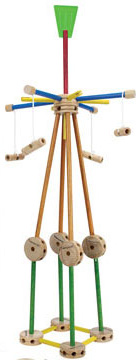
An earlier post has all the materials for the Tinkertoy tower building exercise and it was published by Coff & Hatfield (2003) in JSME (Full text here). This variant of the exercise is especially valuable for teaching entrepreneurship as it focuses on the need to pivot from an initial plan/idea. Recent work (Kirtley & O’Mahoney, 2020) demonstrates how difficult the decision to pivot can be but this may be hard to fully convey to students without their experience of struggling to recognize the need to pivot. The modification is simple. During the 10-minute planning period, teams should:
- Develop an initial plan/design for their tower.
- Anticipate what might go wrong with their initial plan (as with the scenario planning variant).
- Develop an alternative plan or adjustment that addresses the concern.
- How would they know that there is a need to change the plan.
- When would they know (how many seconds into the implementation period).
As with all Tinkertoy variants, many of the towers will fall at the very end and the teams will have missed their opportunities to adapt. Here, the debrief focuses on how they would design a test to identify what would go wrong (as in lean startup). For example, I have used Builderific toys instead of Tinkertoys which are quite flimsy. A good test would be to attach 3 pieces together and hold them out. It will be quickly apparent that the pieces bend and that the tower may not be stable. This can be determined in 20 seconds if they think to do it. The issue is that teams do not think carefully about how they would test their hypotheses even when they are prompted that something might go wrong. This clearly drives home the value of testing assumptions as well as the challenges of knowing when one needs to pivot from their original plan. Here are Coff’s slides as well as Coff’s spreadsheet which will help you administer the exercise more efficiently.
Contributed by Russ Coff
 Carpenter Strategy Toolbox