
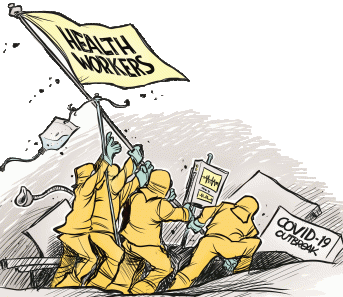
 I have taught during numerous crises (various wars, 911, 2008 crash, etc.) and always regretted missing opportunities to bring the events into the classroom. So how can we encourage our students to think strategically about the COVID crisis? Here are a few ideas for discussion or team projects (but please add more ideas in the comments):
- Dynamic capabilities and Resource Redeployment. How can different types of firms redeploy their resources in this crisis to: 1) help others survive the pandemic, and/or 2) keep the business from going under? How does this redeployment lesson link to other types of challenges? Consider, for example, Eight Oaks’ distillery conversion to produce hand sanitizer.
- Resource Acquisition & Retention. Many resources (especially Human capital) have been released. This could be an opportunity for some firms to access resources. For others, the challenge is to retain the resources through the crisis so they are able to ramp up once the crisis passes. How should firms respond?
- Firms’ Ethical Responsibilities. The two issues above raise inherently ethical problems. What are the firm’s responsibilities to its employees? To shareholders? To society? To survive?
- Generic virus strategies. China opted for extensive testing, isolated those who test positive from their families, and limited travel. The policies are well aligned (like a generic strategy) to limit spread. Is there an alternative aligned strategy involving limited testing? To what extent are countries “stuck in the middle?”
- Technology strategy. What new technologies can be deployed to fight the virus? For example, Kinsa produces a connected thermometer that allows them to map parts of the US where there are unusual fevers— a week before people need hospitalization. How can this new resource be effectively deployed?
- Entrepreneurial Strategy. What business opportunities are created by the crisis? How can an entrepreneur pursue them when resources are scarce? What are the implications for social entrepreneurship?
- Global strategy. How can firms adapt to disrupted supply chains? Are there global opportunities created by the crisis? Along the lines of the first bullet, this could be opportunities to help those in hard hit areas or those that allow the firm to survive.
- Diversification. Are there portfolios of businesses that are more or less likely to survive COVID? What do firms need to do to leverage those parts of their portfolio? What is the role of the corporate HQ?
- Rigorous Data Analysis. The media presents data on cases and deaths at the country level. There are so many questions one might raise. Is the country the right level of analysis? Given the limited testing in some countries, does the number of known cases even provide useful data? How do we interpret missing data in countries like China and Russia?
Contributed by Russ Coff
 Theory is, by definition, a simplification of reality. A useful theory is parsimonious in that it reflects the most important details of the context and allows for reasonably accurate predictions (see a
  Carpenter Strategy Toolbox