The Gap: “For kids/by kids”
Reply

Contributed by Russ Coff
 Here are a series of news articles that one can distribute (not all are really needed). In order to assess Google’s prospects for creating value, one must evaluate the following key sources of uncertainty:
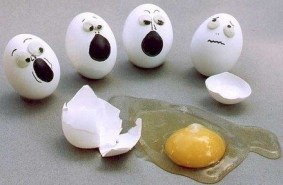 The essence of this exercise is simple. Teams must build a device that will catch an egg dropped from 25 feet (e.g., a stairwell). The trick is that they must build it from items purchased in an auction. As such, items that are easy to use (e.g., an old pillow) are very expensive while items that are hard to imagine a use for (a brick) are cheap. Profit is determined by 1) succeeding in the task of catching an egg and 2) having the lowest cost function. As such, this demonstrates Barney’s (1986) notion of superior expectations in strategic factor markets.
Now that you see where this is going, here are the rest of the details.
Contributed by Aya Chacar
Contributed by Russ Coff
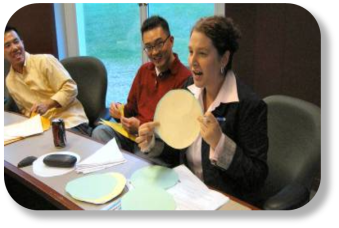 In the Global Game exercise students are placed in groups with asymmetric resources with a task to maximize “points” produced. In order to maximize output, they need to trade resources (e.g., alliances) with other teams. The resources include raw materials (e.g., paper), technology (e.g., scissors and templates), knowledge (of the point system), and even people. They can also merge teams.
The following is a brief overview of the exercise: Continue reading
Alphabet soup is an exercise which focuses students to think about the managerial decision process, and the limits to how we analyze complex problems.  The key points are that managers deal with complex problems, and often use cognitive frameworks to help constrain the problems. These frameworks tell the managers what information is needed; however, unless the managers understand that all frameworks have limitations, these frameworks can fall trap to cognitive biases.

Requires two 25-piece puzzles. Prior to the exercise, two pieces from each puzzle should be blacked-out with an indelible marker. Additionally, one of the fifty pieces should be placed in the trainer’s pocket prior to the training. Continue reading
 Click here for a video that illustrates a Real Option to Defer. How to use the last photos on a role of film…
Contributed by Russ Coff
Funny DHL commercial to illustrate the value of alliances. One might wonder if the alliance is stable over time though…
Contributed by Russ Coff
This video shows the world record in cup stacking. The task requires speed in a repetetive task. It might be thought of as a capability however, it is clear that it is not about flexibility or adaptability. This helps to illustrate the distinction of a dynamic capability — this is not strategy under uncertainty.
A bit of trivia is that Emily is the CEO’s daughter for SpeedStacks, the company that makes specialized cups for stacking and the primary backer of the “World Sport Stacking Association.” She might actually be a resource for her father’s company…
Contributed by Russ Coff
This video shows a play one could never plan. Might it be possible to train a team to improvise when the opportunity presented?
Contributed by Mason Carpenter
The Tinkertoy exercise is simple but exposes students to a variety of issues linked to formulating and implementing strategy. This deeper application of the common ice breaker has been published by Coff & Hatfield (2003) in JSME (Click here for full text). There are a number of slight modifications that make the exercise very valuable for different topics in a strategy course. For example:

The exercise can demonstrate key features of the resource based perspective and first mover advantage by having the teams execute in waves and watch how much imitation occurs (often team stick to their planned strategy even if they watch another team fail using that plan).
See the other two if you click here: Continue reading
Here the lions wait for their food to deliver itself. Did they know to wait under that tree? It is very funny but also explores why planning is necessary…
Click Here to download a video of lions “hunting”
Contributed by Russ Coff
 Carpenter Strategy Toolbox