
The $104B merger between AB InBev and SABMiller makes a great holiday addition to your classroom.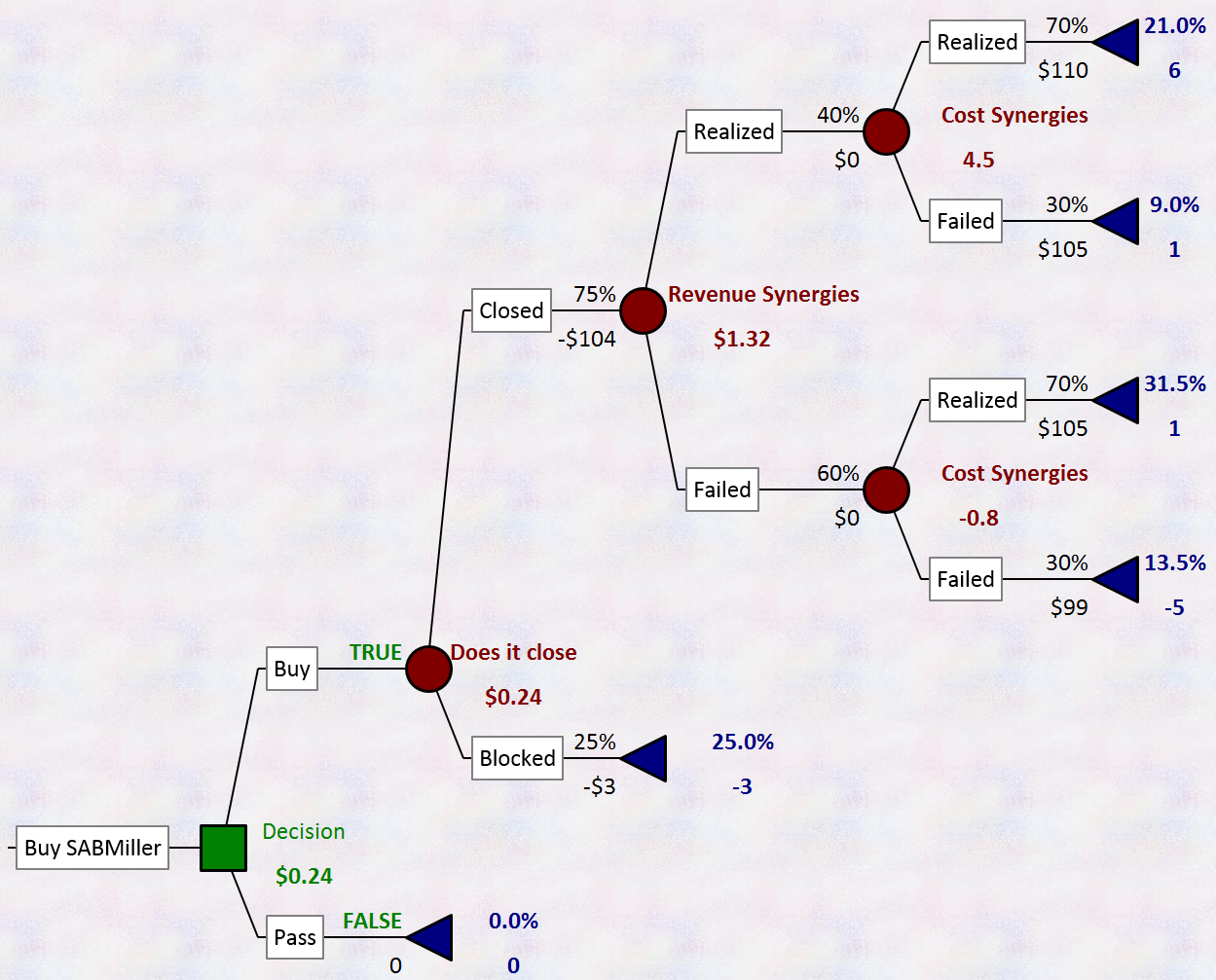 While it is largely a corporate strategy question, I used this discussion to kick off my course and I plan to come back to it as we hit various topics. Here is a packet of news articles that I used as the basis of the case. I also had students complete a brief online poll in advance of the class. This allowed me to start by summarizing their positions and to call on people who I knew had relatively unusual opinions. I used the case to show them how to draw a decision tree (click the image to enlarge) reflecting the uncertainty associated with the acquisition. Of course, it also frames topics throughout the course. Here are a few examples:
- Internal capabilities. AB InBev’s capability to conduct acquisitions and to cut costs.
- External analysis. Market structure for beer in different countries (namely Africa and China which drive this deal). Also, we compared the market structure for micro- and macro-brews. Of course, these mega-brews act to control distribution channels so barriers to entry are a key part of the game.
- Competitive dynamics. Of course this is a game among the rivals but it also includes adjacent industries (like spirits).
- Corporate. What are the logics for value creation? For example, to what extent does scale lower manufacturing costs as opposed to purchasing power or other mechanisms. At what point is a larger scale no longer an advantage?
- Strategic factor markets: The M&A context makes it clear that most of the synergies go to the target (especially at the 50% bid premium).
- Global. As indicated above, this is mostly about entry into new markets (China and Africa, among others).

Contributed by Russ Coff
 Apple’s product is optimized to be more efficient to their own proprietary operating system while Google is optimizing development efforts across platforms. Indeed, Microsoft’s
  Ive “worked closely with the late co-founder Steve Jobs, who called Mr Ive his spiritual partner on products stretching back to the iMac.” As before, the reliance on a single person in this role raises key questions: An article published in the New Yorker earlier this year described how “Mr Ive had been describing himself as both ‘deeply, deeply tired‘ and ‘always anxious’ and said he was uncomfortable knowing that ‘a hundred thousand Apple employees rely on his decision-making – his taste – and that a sudden announcement of his retirement would ambush Apple shareholders.‘” Can this be described as an organizational capability? An organizational routine? A dynamic capability? Does it matter that the capability is largely embedded in a single person who is not an owner? All good questions to kick off a nice class discussion…
 Once thought to be as stable a market as can be, new business models increasingly challenge the landscape. The link above includes mostly additional services such as “Grocerants” (upscale restaurants within grocery stores), fishmongers, butchers, more delivery options. Also,
  Abercrombie & Fitch is struggling (
 The near field communications (NFC) technologies that they rely on require that merchants invest in new technology at the point of sale. Samsung has acquired
 The Lion King brought in over 2 billion and the box office was just a small part (see the
  Carpenter Strategy Toolbox