
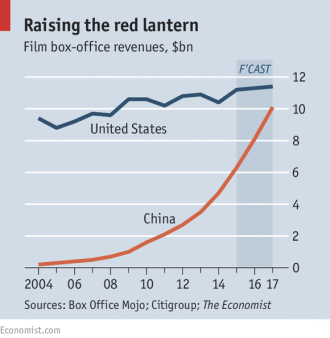
 How do firms modify their products so they will be well-received in the most promising global markets? Case in point: Hollywood’s biggest movies are being subtly reworked to appeal to Chinese audiences. Since, that market may soon outstrip the U.S. to become the most lucrative movie audience in the world (see chart). Movies like Warcraft and Now You See Me 2 have been huge successes in China even though their domestic performance has lagged. Why? The Warcraft cast features Daniel Wu, a very bright star in China, who may have been unrecognizable as the orc Gul’dan, but his promotional efforts were important to the film’s success. Similarly, Now You See Me director, Jon M. Chu, cast star Jay Chou and filmed a portion of the movie in the Chinese region of Macau. The movie industry is a great example of product design for market entry. The following video frames it nicely for students interested in addressing barriers to market entry.
Contributed by Russ Coff

 The
The 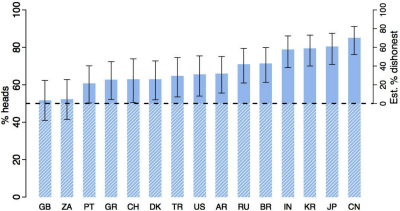 Are there cultural norms for telling the truth?
  Most of the media has chalked up President Elect Trump’s phone call with Taiwan’s President, Tsai Ing-wen, as driven by
 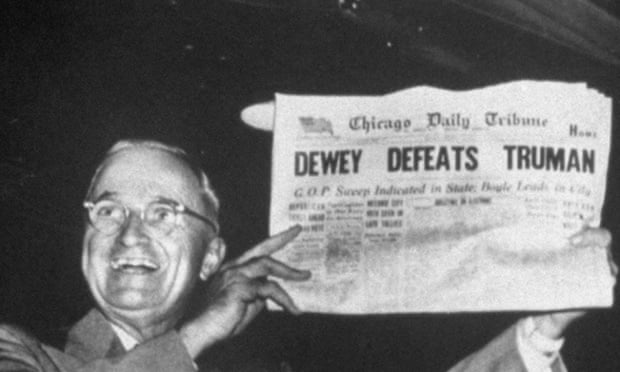 This isn’t the first time polls have been wrong. The election of Donald Trump was a shock to many college students (as well as the press) and this may warrant some class time. Some instructors responded by
  Why isn’t the BCG matrix dead as a framework? I still consistently find that my students have been exposed to it (generally in Marketing). They don’t even understand that it is a framework for internal capital markets (where firms add value by serving as a source of funding) or that it is hopelessly flawed. It’s a dog, divest right away. If the sale generates cash, funnel it to any other management framework (even SWOT) and I’m sure it will create value.
 What follows is a brief description/outline of the lecture. While it certainly won’t do it justice, it may offer some important ideas for instructors to explore.
 The augmented reality (AR) game,
  Successful strategy is often a combination of luck firm specific skills and favorable conditions. AmorePacfic makes a great ripped-from-the-headlines case since it rose to be the #1 South Korean firm buoyed by a growing and large domestic demand from a growing population. Hallyu – the Korean equivalent of Hollywood was also a driving factor as South Koreans want to look like their favorite stars and use the same cosmetic products and that includes men. In fact, it is estimated that a whopping 20% of South Korean men use cosmetic products on a regular basis. AmorPacific capitalized on this growing trend by building up its brand and investing in R&D and ultimately riding the popularity of K-pop and K-movies to expand internationally. At a time that demand is softening, K-cosmetics are still growing with exports increasingly exceeding imports and Korean cosmetics brands now more popular than European brands in China and increasing their penetration in many countries including China, Hong Kong, Japan, the US, Vietnam, and in a surprising list of other countries such as Poland where their addition to Sephora’s product line and other large retailers will ensure broad distribution. How has a $150 1.7 oz managed to gain global popularity? Some materials for the case might include:
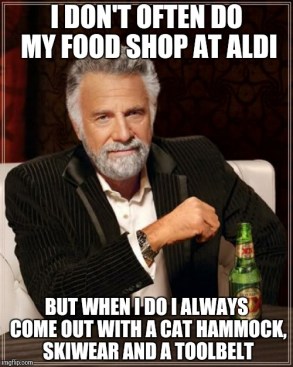 Aldi has been crushing the competition for years and makes an excellent case of how organizational alignment can deliver a strategic advantage (cost in this case).
 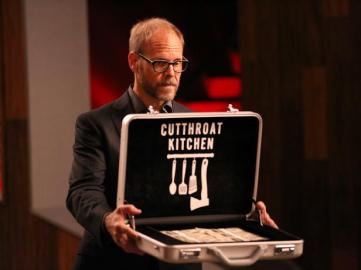 This cooking competition show begins with an auction of resources needed to cook including space to work and cooking utensils. The contestants bid to preempt rivals by obtaining access to key resources while saddling them with inferior resources. This is ultimately quite similar to the
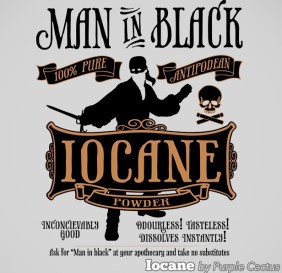 Most students quickly grasp the concept of game theory–figuring out what your opponent is likely to do helps you decide what you ought to do. As this clip shows, however, failing to understand the real decision choices to be made can lead to deadly, but funny results. In class, after introducing simultaneous vs. sequential games, I show the clip, pausing it just before the 2:11 mark. At this point the poison is in the goblet, and I ask the students who haven’t seen the movie which goblet they think is poisoned. I record answers, and then show the clip (up to anywhere between 4:45 and 5:02). I then ask if they were surprised. I then show the remainder of the clip, and we discuss what mistake Vazinni made. Students see the real payoff matrix as: a) if I (Vazinni) guess wrong, I’m dead; b) If I guess right, then the Dread Pirate Roberts knows it too has incentive to kill me before he dies. I only live if Iocane powder kills instantly. My correct answer can only be not to drink either goblet if I want to live. After watching this video clip and class discussion, students can:
 Managing change is given little time in most strategy courses. We often understate how difficult strategic change actually is and then wonder why organizations struggle so much with implementation (and our students think its all common sense). You can think of it as walking blindfolded on a tightrope between two solid foundations. During the transition, there is great uncertainty about whether the desired path is attainable. This, of course, is another way of looking at Lewin’s unfreeze/change/refreeze model. This video can help to illustrate the issue:
 Economics-games.com
 Carpenter Strategy Toolbox