
The $104B merger between AB InBev and SABMiller makes a great holiday addition to your classroom.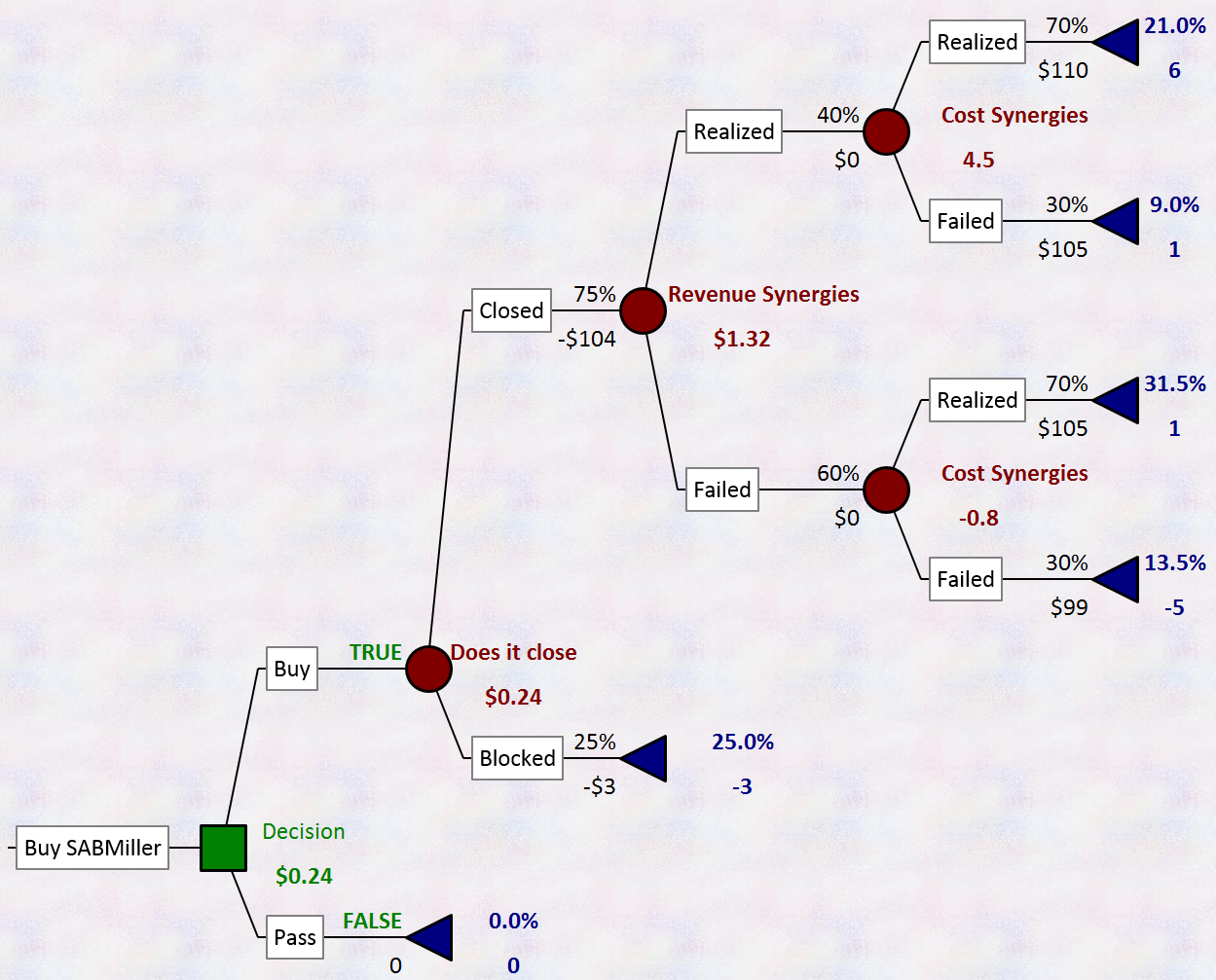 While it is largely a corporate strategy question, I used this discussion to kick off my course and I plan to come back to it as we hit various topics. Here is a packet of news articles that I used as the basis of the case. I also had students complete a brief online poll in advance of the class. This allowed me to start by summarizing their positions and to call on people who I knew had relatively unusual opinions. I used the case to show them how to draw a decision tree (click the image to enlarge) reflecting the uncertainty associated with the acquisition. Of course, it also frames topics throughout the course. Here are a few examples:
- Internal capabilities. AB InBev’s capability to conduct acquisitions and to cut costs.
- External analysis. Market structure for beer in different countries (namely Africa and China which drive this deal). Also, we compared the market structure for micro- and macro-brews. Of course, these mega-brews act to control distribution channels so barriers to entry are a key part of the game.
- Competitive dynamics. Of course this is a game among the rivals but it also includes adjacent industries (like spirits).
- Corporate. What are the logics for value creation? For example, to what extent does scale lower manufacturing costs as opposed to purchasing power or other mechanisms. At what point is a larger scale no longer an advantage?
- Strategic factor markets: The M&A context makes it clear that most of the synergies go to the target (especially at the 50% bid premium).
- Global. As indicated above, this is mostly about entry into new markets (China and Africa, among others).

Contributed by Russ Coff
 Once thought to be as stable a market as can be, new business models increasingly challenge the landscape. The link above includes mostly additional services such as “Grocerants” (upscale restaurants within grocery stores), fishmongers, butchers, more delivery options. Also,
  s/year. A
  They have offered $600 million more for Family Dollar than the preferred suitor. Two things may be preventing Family Dollar from switching partners: 1) concerns that a Dollar General deal would be thwarted by anti-trust regulators, and 2) the Family Dollar CEO would lose his job if Dollar General takes over. Of course, they say the second issue is not on their minds. This makes a great “ripped from the headlines” case (
 Here are excepts from the abstract: Despite its ubiquity, many students struggle to understand and apply value chain concepts. JetFighter uses a complex manufacturing process (intricate paper planes) to enhance students’ value chain competencies. Teams are use value chain concepts to develop innovative strategies to fulfill customer requirements and outperform rivals. The exercise involves two production periods with a brief value chain lecture occurring after the first period. Given that teams typically lose money in the first round, their motivation to learn is enhanced as they are immediately provided an opportunity to apply this knowledge in the second period. Here are materials for the exercise:
 You could easily fill an hour by just playing the videos below, saying “discuss,” and then stepping out of the way. I use the videos (all 3) along with the available case study —
