Can you plan like a Chipmunk?

Ok, another silly one from ONN. On the other hand, there is a robust literature on cognitive bias and economic short-termism (see this AMR by Laverty). Chipmunks plan for a whole season ahead — not bad actually. As such, this might be a good lead in for a discussion on bias in strategic decision-making.

Contributed by Russ Coff

Prescription for Corporate Governance

This exercise from Norman Sheehan and Kay Keels addresses corporate governance and ethics (see the Jensen Pharma Teaching Note). Here is the setting: A pharmaceutical firm’s board must decide what to do with its best selling drug, Dekanor, in light of research that suggests that the drug may be causing serious harm. This reflects the ambiguity and choices Merck’s and Pfizer’s boards may have experienced in the years before they knew if their “blockbuster” drugs, Vioxx, Bextra and Celebrex, were harming patients. For example, the role play includes the impact of social media, pressure from rivals, and tactics sometimes used by pharmaceutical companies to discredit negative research studies. Board members are asked to choose between options including: 1) preemptively remove Dekanor from the market, 2) continue selling Dekanor but add additional product warnings and stop actively marketing the drug, or 3) continue to aggressively market the drug and fight to keep the FDA from banning it. The 14 roles include Jensen’s Chairperson and CEO, its five board members, and eight managers (click here for the Jensen Pharma Roles and Agenda). Each must balance his/her corporate agenda with his/her personal agenda. For example, some own considerable amounts of valuable stock that may affect their decisions.

Contributed by Norman Sheehan and Kay Keels

Boycotting HBR? Some Alternatives…

You may have followed the debate about HBR’s policy prohibiting professors from linking suggested HBR readings to their own library’s paid subscriptions (see Joshua Gans’ blog posts on this and his Financial Times article on HBR and their journal list). I have increasingly used McKinsey Quarterly which makes their articles available for free (you need to register but that’s free). Here are some HBR alternatives that seem to work well (often by authors you know well):

Strategy process & org change

Internal Analysis and Competitive Advantage

Continue reading

Baby Click Me One More Time

Market signals can be rather noisy and firms may over react or miss the signal entirely. In a similar way, the resource based view draws on causal ambiguity as an isolating mechanism — firms may misread noisy observations and imitate the wrong thing. This clip illustrates that problem as a firm ramps up to meet demand triggered by unusual activity on its web page…

Contributed by Russ Coff

The Problem with Credible Commitment

Credible commitment sends a valuable signal but can only be achieved at a substantial cost. Unfortunately, that cost can create challenges for implementing different strategies later. A tattoo might be considered one form of credible commitment…

Contributed by Russ Coff

Get Out of Jail Free

There are many game theory simulations available online to supplement lectures and cases. If you have limited class time or are teaching a distance course, these simulations can be especially valuable because, unlike video lectures or PowerPoint voice overs, these are quite interactive. Here are some examples:

If you really need a video, this one from Greg Mankiw’s page should work. See also the classic Dilbert Prisoner’s Dilemma video.

Contributed by Russ Coff

Failing Newspapers Affect Crazy Loons

Ok so here is another funny Onion News Network story of how the death on newspapers affects crazy loons who fill their houses with old newspapers. However, there is a serious issue on how firms ensconced in old technologies respond to strategic challenges. Here is an academic paper by Adner and Snow on the topic. You may also be interested in their HBR article on the topic that may be useful for teaching.

Contributed by Russ Coff

Apple’s Rotten Core Competency?

Apple’s board is growing impatient and is calling for increased innovation as they try to put the loss of Steve Jobs behind them. At the same time, projections indicate that their anticipated product changes will be incremental at best. A recent article coins the term “frosted glass effect” to describe the incremental innovations that signal a fast moving challenger will soon leapfrog over a stodgy slow moving incumbent (like Apple). Not to be left out, the Onion has entered the fray as well. In short, stakeholders are wondering how critical Jobs was to Apple’s “organizational” capabilities — Has the core competence really rotted away? Some discussions of dynamic capabilities place great emphasis on organizational routines as the key elements that drive the ability to acquire, integrate, recombine and release resources and capabilities (e.g., see Winter). The importance of Jobs, in this case, shifts our attention to key individuals who may be essential components in harnessing and directing routines. Without a rudder, the routines may lose much of their value. Of course, this steers us solidly into a micro-foundations perspective (e.g., see Barney and Felin or Foss)…
Contributed by Russ Coff

Madonna vs. The Stones?

A longstanding debate has compared the “static” resource-based view to dynamic capabilities. When does competitive advantage stem from staying the same and when does it demand constant change? This article in the Financial Times explores how the Rolling Stones have maintained their advantage by avoiding change. The article discusses how change may be bad for goods that have emotional appeal. In contrast, Madonna has reinvented herself multiple times. This is most apparent in her reinvention tour (below). The musical legends may help to bring this discussion to life.

Contributed by Aya Chacar

Google Graveyard: An optional story

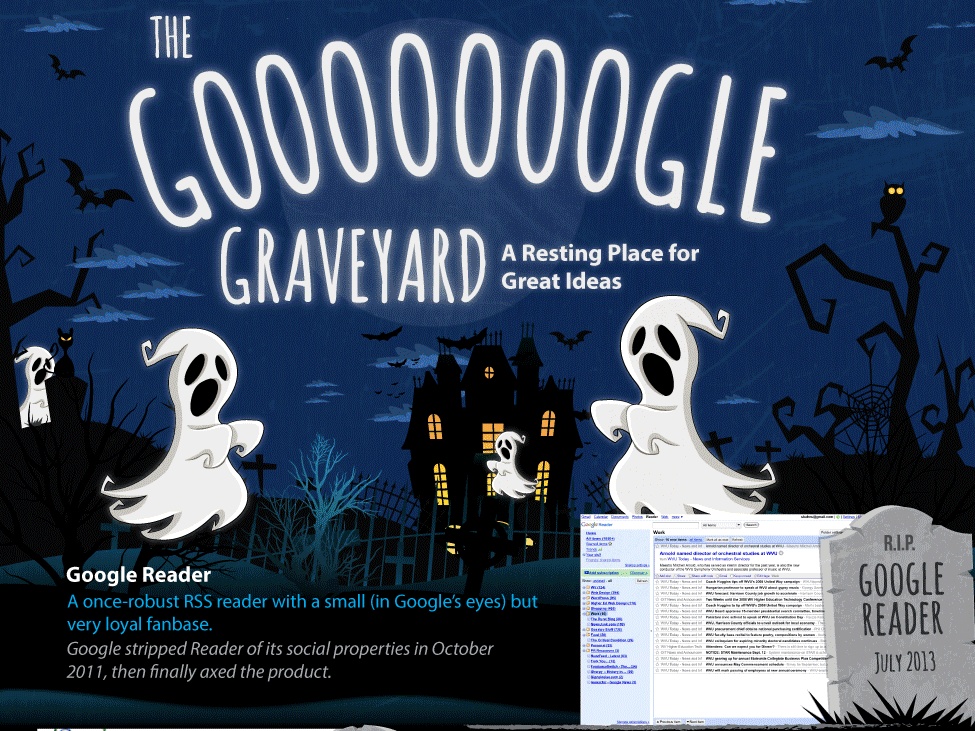
Google has brought many products and ideas to market that have been unsuccessful and ultimately pulled back.GoogleGraveyard Forbes recently published an infographic that illustrates many of these. This is valuable to point out the uncertainty surrounding new products and services and how a real option portfolio might be an appropriate tool for making investment decisions. Ultimately, the process may look a bit like a venture capital portfolio. Given Google’s successes, we may forget their many ideas that have not worked well in the marketplace. There are a number of other resources here that help to focus on real options as a strategic tool.

Contributed by Russ Coff

Keystone Cops in a Detroit Robbery

Competitive advantage is not visible to all stakeholders at the same time. This is why entrepreneurs can have an advantage in negotiating with stakeholders who come late to the game. The bank robbery below illustrates how even a small advantage in awareness can change the game.

Contributed by Karl Wennberg

Schmidt on Disruptive Technologies

McKinsey has put together a video of Google’s Eric Schmidt discussing disruptive technologies. It is divided into four segments: 1) Biology goes digital, 2) Materials and manufacturing, 3) My computer my friend, and 4) Man vs. machine. They also have a transcript of his comments available.

Contributed by Russ Coff

Developer Releases Pirated Game

Greenheart Games developed a game (Game Dev Tycoon) where the objective is to manage a video game company. However, they did something a little different. They simultaneously released a “cracked” version of the game that was identical except that player’s new products would be pirated. Eventually, the player’s company goes broke since they can’t make any money. Here is their blog post (or pdf in case the site goes dark) describing what happened (e.g., how users of the cracked version complained that they couldn’t win). This is a great vehicle for discussions of ethics, intellectual property, and even game theory. This short video report describes the ploy:

Contributed by Rich Makadok

Teens Enriching Uranium (ONN)

The Onion offers another entertaining report about teens enriching and selling uranium. While the discussion of “Toping” is a bit silly, the question about stemming the diffusion of some innovations is central to technology strategy. More seriously, why don’t we see wider diffusion of this 75 year old technology?

Contributed by Russ Coff

Failing … to Succeed

Peter Klein writes, “To illustrate the importance of experimentation and learning, I showed my students the Michael Jordan ‘Failure’ commercial. Inexplicably, they were not moved to tears, as I was.” J.K Rowling’s 2008 graduation address at Harvard is also a nice example though it may be a bit long to play in class.

Contributed by Peter Klein

Starbucks’ Dual Advantage

BusinessWeek offers a nice analysis of Starbucks’ decision to lower prices on its premium coffee. Rita McGrath describes the “hourglass economy” as thick markets for low cost and highly differentiated products. Accordingly, Starbucks is keeping prices high for premium drinks in its stores but dropping the price of coffee by 10% to draw in more price conscious consumers. This strategy leverages Starbucks’ lean supply chain operations that give it a very low cost structure despite offering premium products. Ultimately, this puts higher cost rivals at a disadvantage because Starbucks can offer a better value proposition.

Contributed by Russ Coff

Bullets Recalled for Being too Safe

The Onion offers a news analysis of a recall of defective bullets that fail to kill effectively. Of course, the discussion is a bit silly but this can be used to highlight how blame is assigned in organizations as well as how managers operate under conditions of causal ambiguity

Contributed by Russ Coff

Free Org Change Videos

Education Portal has put together a series of videos on Organizational Change that seem like a nice addition especially for online or part time courses. Education Portal Academy offers these videos for free. The content is fairly basic but some of it might be very useful to augment other course materials. This could help you cover these topics outside of class if you want to do an experiential exercise in class (see, for example, the org change ruse on this site) or if you want to give students some additional background resources.

Contributed by Russ Coff


Proof of a Bad Strategy…

Kathy Eisenhardt has a classic paper describing how “slow” decision makers tend to explore one alternative until it has completely failed rather than considering other alternatives. When facing uncertainty (noisy signals), managers often need strong evidence before altering their opinions. This video depicts the consequences of waiting for such strong evidence.

Contributed by Russ Coff

Perception Drives Strategy

Another in a series of (entertaining) videos that illustrate perceptual biases. In the context of strategy, decision-makers inevitably have incomplete data from which to draw conclusions. In this context, behavior and choices are ultimately driven by perceptions as opposed to some objective observation of facts. You may also be familiar with the classic video where the task is to count basketball passes and viewers get to involved with the task that they miss the gorilla that walks through the middle. Here is a related article that shows how radiologists also miss the gorilla when it is in the middle of a lung scan.

Contributed by Russ Coff